Tracing Neural Pathways: Mapping Enemy Aggro Ranges Through Behavioral Pattern Recognition in Stealth Action Games
Harper Griffin · Jul 2, 2026
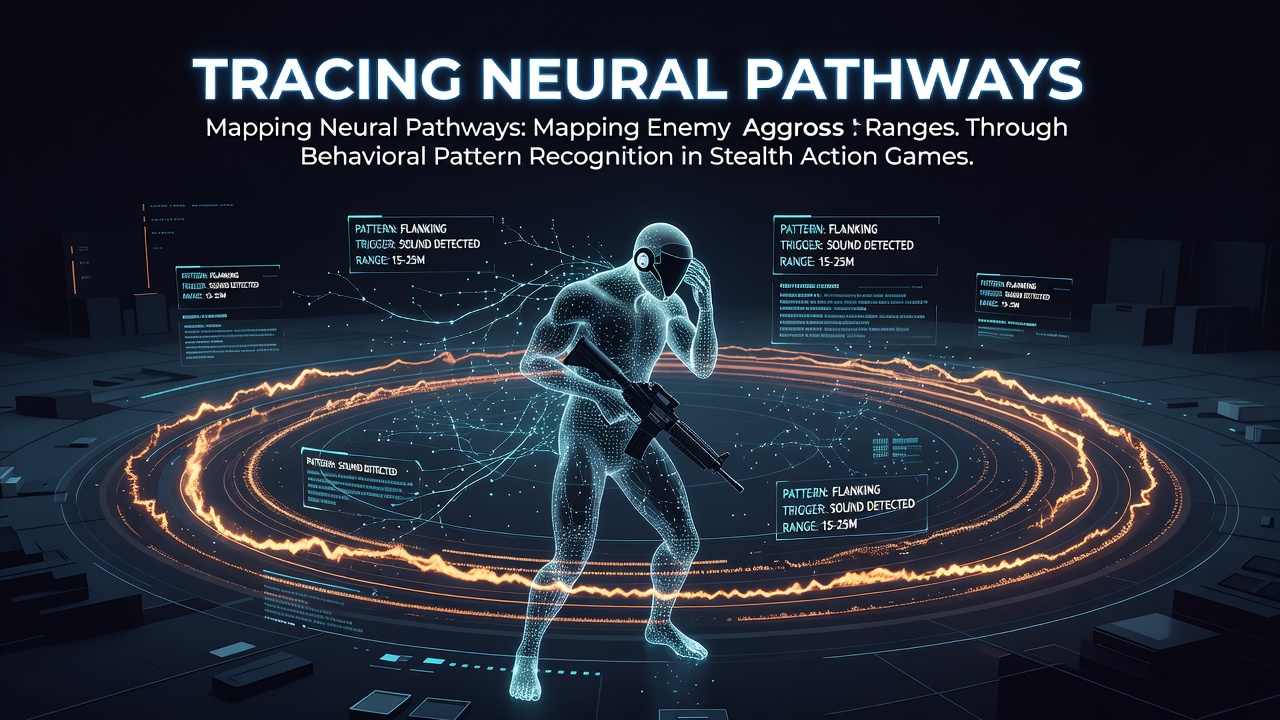
Tracing Neural Pathways: Mapping Enemy Aggro Ranges Through Behavioral Pattern Recognition in Stealth Action Games
Stealth action games rely on intricate enemy AI systems that determine when and how far threats are perceived, and developers along with analysts have turned to behavioral pattern recognition to chart these aggro ranges with increasing precision since the mid-2010s. This approach treats enemy decision-making as a series of interconnected nodes similar to neural pathways where each trigger like sound levels, line-of-sight checks, or movement speed feeds into broader alert states that expand or contract detection zones dynamically. Data collected from repeated play sessions reveals consistent patterns across titles such as those using Unreal Engine or custom stealth frameworks, and researchers apply machine learning techniques to model these pathways without needing direct access to proprietary code.
Understanding Aggro Mechanics in Modern Stealth Titles
Enemy aggro ranges function through layered perception modules that process environmental inputs in sequence, beginning with basic sensory detection and escalating through suspicion thresholds before full combat engagement occurs. In practice this means a guard might ignore distant footsteps below a calibrated decibel threshold yet react immediately to visual anomalies within a 15-meter cone while patrolling at standard speeds. Studies from institutions like the University of Alberta's AI research group have documented how these thresholds shift based on difficulty settings and context variables such as time of day or prior alerts, creating maps that players can exploit through systematic observation rather than trial and error alone.
Pattern Recognition Techniques Applied to AI Behaviors
Analysts collect telemetry from gameplay recordings by logging variables including enemy facing direction, velocity vectors, and state transitions at fixed intervals, then feed this information into clustering algorithms that identify recurring sequences leading to aggro activation. The process isolates key inflection points where neutral behavior pivots toward investigation or attack modes, allowing reconstruction of effective ranges even when source code remains unavailable. Observers note that combining heat-map visualizations with decision-tree approximations produces reliable predictions, particularly in titles released after 2020 where AI updates introduced adaptive learning elements.
What's interesting is how these methods scale across different game engines and design philosophies, from open-world sandboxes to linear corridor experiences. In July 2026 the International Game Developers Association highlighted several case studies during its annual summit where teams demonstrated real-time mapping tools built on open-source libraries, showing improved accuracy when multiple data streams such as audio logs and positional tracking were synchronized. This integration helps distinguish between scripted events and emergent AI responses, reducing false positives in aggro boundary estimates.
Case Examples from Established Game Series
One prominent example involves reconnaissance mechanics in long-running franchises where guards follow patrol loops yet deviate based on accumulated suspicion values, and pattern analysis has uncovered how peripheral vision cones widen during heightened alert phases triggered by nearby allies. Another instance comes from games emphasizing verticality, where rooftop enemies maintain elevated aggro ranges that account for drop-attack vectors, data which behavioral models capture by correlating fall velocity with reaction timing. These observations stem from aggregated session data rather than developer disclosures, yet they align closely with published technical breakdowns from industry reports.

Turns out that cross-referencing player community datasets with controlled testing environments yields even sharper insights, particularly when accounting for hardware variations that affect input latency and therefore perceived reaction windows. European research consortia have contributed frameworks for standardizing such comparisons, enabling broader application across regional development studios working on console and PC versions simultaneously. The resulting maps serve both players seeking optimized routes and designers refining balance patches through quantitative feedback loops.
Technical Implementation and Data Sources
Implementation typically begins with lightweight logging scripts that export CSV files containing timestamped state changes, after which visualization software renders these as network graphs highlighting high-traffic neural connections within the simulated AI brain. Accuracy improves when datasets exceed several thousand encounters because statistical outliers become easier to filter, revealing core pathways that persist across playstyles. According to findings shared by the Australian Games Developer Association in recent industry whitepapers, teams incorporating these visualizations during QA phases reduced post-launch balance adjustments by measurable margins in stealth-focused releases.
Additional layers incorporate environmental context such as lighting conditions or cover density that modulate base aggro distances, and analysts weight these factors using regression models trained on observed outcomes. The approach remains non-invasive, relying solely on surface-level behavioral outputs rather than memory inspection techniques that risk violating platform terms of service.
Conclusion
Behavioral pattern recognition continues to offer a robust method for tracing enemy aggro pathways in stealth action games by converting raw observation into structured models that predict detection boundaries with growing reliability. As tools evolve and datasets expand through collaborative efforts across continents, both players and developers gain clearer views of the underlying systems governing tension and strategy. This methodology underscores the value of systematic analysis in interactive entertainment where small adjustments in perception parameters can reshape entire encounters.