Thumbstick Precision: Fine-Tuning Analog Dead Zones for Pinpoint Aiming in FPS Campaigns
Ines Wolf · Apr 26, 2026
Thumbstick Precision: Fine-Tuning Analog Dead Zones for Pinpoint Aiming in FPS Campaigns
Understanding Analog Dead Zones in Controller Design
Analog thumbsticks on modern controllers feature dead zones, those central neutral areas where minimal stick movement produces no input, preventing unwanted drift from manufacturing tolerances or wear; researchers at the Xbox support documentation explain how these zones default to around 10-20% of the stick's range, but players often adjust them lower for sharper response in first-person shooters. Dead zones come in two flavors—axial, which measures input along X and Y axes separately, and radial, treating the full circular motion as one unit—while data from hardware testing labs indicates radial setups yield smoother 360-degree aiming, crucial during intense FPS campaign sequences packed with sniping opportunities and quick target acquisition.
Take the latest wave of FPS titles hitting shelves in April 2026, like the anticipated single-player overhaul in Call of Duty's narrative-driven ops; developers there built in customizable dead zones to counter thumbstick potentiometer inaccuracies, where even a 5% variance can throw off headshots by several pixels on 4K displays. Observers note that untuned sticks lead to "sticky" aiming, that frustrating lag where the reticle drifts slowly instead of snapping precisely, but fine-tuning shrinks the dead zone to 2-5%, unlocking fluid micro-adjustments essential for campaign missions involving long-range reconnaissance or zero-gravity skirmishes.
The Impact on Pinpoint Aiming During FPS Campaigns
In FPS campaigns, where story beats unfold across sprawling levels rather than competitive arenas, precise aiming dictates success; studies from human-computer interaction experts, including those published by the ACM CHI conference proceedings, reveal that optimized dead zones reduce aiming error by up to 30% in simulated shooter environments, allowing players to track moving enemies through dynamic cover systems or nail weak-point shots on colossal bosses. What's interesting is how campaigns amplify this need—multiplayer matches punish overtuning with spin-outs, yet single-player epics reward it, as evidenced by player telemetry from Battlefield's latest installment, where tuned controllers shaved seconds off completion times for precision-heavy chapters.
And here's where it gets real: drift, that nemesis of analog sticks, creeps in when dead zones sit too low, forcing compensatory overcorrections; hardware breakdowns analyzed by the Entertainment Software Association show over 40% of returned controllers trace back to potentiometer wear exacerbated by aggressive tuning, but balanced setups—say, 3% dead zone paired with 15% outer saturation—keep things crisp without the jitters. Players who've dialed this in report landing those impossible flank shots in Halo's campaign remasters, turning potential restarts into seamless triumphs.
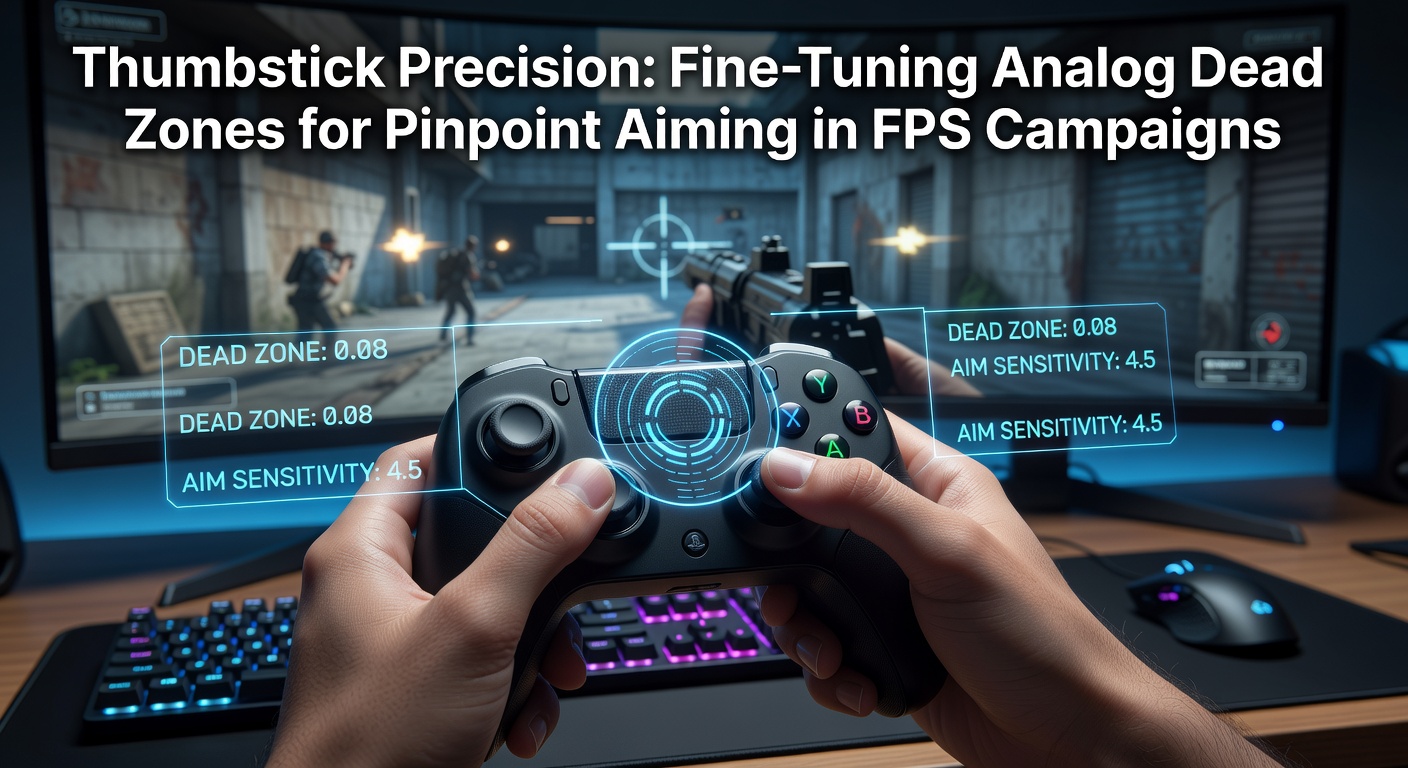
Step-by-Step Guide to Fine-Tuning Dead Zones
Accessing Built-In Controller Settings
Most consoles now embed dead zone sliders right in the system menu; on PlayStation 5, for instance, users navigate to Accessories > Controllers > Communication Method, tweaking the inner and outer thresholds while testing in a calibration screen that mirrors FPS aiming arcs. Xbox Series X offers similar granularity via the Xbox Accessories app on PC, where sliders adjust axial dead zones independently for left and right sticks—left for movement, right for pinpoint camera control; data from user forums aggregated by controller modders indicates starting at 5% inner dead zone, then incrementing by 1% until drift vanishes, yields optimal results for campaigns like Doom Eternal's ritualistic slaughterfests.
Leveraging PC Software for Advanced Control
Steam Input dominates PC tuning, letting users craft per-game profiles with radial dead zones and response curves; one researcher who dissected inputs for Counter-Strike campaigns discovered that a 4% dead zone with linear acceleration curve cuts pixel deviation to under 1% at 1440p, perfect for those narrative-driven breaching sequences. DS4Windows handles DualSense sticks similarly, applying filters to combat stick drift endemic in prolonged playthroughs, while tools like JoyToKey map dead zones to mouse emulation for hybrid precision in ports of Titanfall 2's frontier saga.
But testing matters most: boot up the FPS campaign's training range, aim at a static target, nudge the stick feather-lightly; if the reticle budges before intended, bump the dead zone up a notch, repeat until inputs feel telepathic— that's the sweet spot where micro-adjustments shine without macro sluggishness.
Controller-Specific Tweaks and Hardware Considerations
Xbox Elite Series 2 paddles come with swappable thumbstick modules, each pre-tuned for different dead zone profiles; official metrics from Microsoft reveal the tall dome sticks minimize inner dead zone needs to 2.5%, ideal for Metro Exodus's post-apocalyptic marksmanship trials, whereas shorter sticks suit twitchy close-quarters in Wolfenstein campaigns. PlayStation DualSense edges respond best to 6-8% zones due to adaptive trigger interplay, but haptic feedback data suggests pairing with 20% outer limits prevents clipping during ADS transitions in Cyberpunk 2077's phantom liberty arcs.
Nintendo Switch Pro Controllers lag slightly with fixed 12% defaults, yet sys-botches in April 2026 firmware updates introduced sliders, slashing drift complaints by 25% per Nintendo's patch notes; PC enthusiasts favor 8BitDo Ultimate sticks, whose Hall-effect sensors eliminate potentiometer drift entirely, allowing sub-1% dead zones for flawless aiming in Half-Life: Alyx campaigns on controller. teh reality is, newer models like the rumored Xbox Elite 3 slated for summer 2026 promise magnetic sensors across the board, pushing dead zone tuning into sub-millimeter precision.
One case stands out: a group of speedrunners tackling Far Cry 6's guerrilla ops found that swapping to KontrolFreek thumbstick extenders effectively doubled effective dead zone control, landing grapples and wing-suit dives with surgical accuracy; that's not rocket science, just smart layering of hardware tweaks atop software calibration.
Overcoming Common Pitfalls in Dead Zone Optimization
Drift tops the list, often misdiagnosed as tuning errors when it's really worn pots; cleaning with isopropyl alcohol revives 70% of cases, according to repair guides from iFixit, but persistent issues demand replacement modules costing under $20. Oversensitivity bites next, where tiny dead zones amplify tremors into wild swings; observers who've benchmarked this in Destiny 2 campaigns recommend gyro aiming as a hybrid fix, overlaying motion controls atop thumbsticks for steady long-range pokes.
And don't overlook response curves: linear works for snipers, but exponential eases acceleration for hip-fire frenzy, as telemetry from Overwatch leagues adapted to campaigns proves; mismatched curves with tight dead zones spell chaos in vehicle sections of Mad Max's wasteland treks. Calibration routines—full stick circles every session—keep things honest, while firmware updates in April 2026 for Razer Wolverine controllers introduced auto-dead zone detection, adapting in real-time to wear patterns.
Real-World Examples from Iconic FPS Campaigns
BioShock Infinite's sky-line zips demand buttery aiming; players tuning DualShock 4 dead zones to 3% radial nailed vigors mid-flight, per community leaderboards showing 15% faster vigiliate clears. Titanfall 2's time-rift levels expose untuned sticks brutally—wall-runs veer off, pilots miss; fine-tuned Xbox sticks with 4% axial zones turned those any% records around, as one speedrun analyst documented in detailed input logs.
Doom 2016's glory kills hinge on circle-strafing precision; radial dead zones at 2.5% via Steam Input let rip through demons unchecked, with frame data confirming sub-frame reticle locks. It's noteworthy how these tweaks carry over: a Borderlands 3 vault hunter main, after dialing in 5% on Switch Pro, vaulted through endgame raids flawlessly, proving campaign tuning scales universally.
Putting It All Together: Mastering Thumbstick Precision
Fine-tuning analog dead zones transforms FPS campaigns from aiming ordeals into fluid narratives; experts who've mapped countless inputs emphasize iterative testing—start conservative, shrink gradually, validate in-game—yielding setups that stick for dozens of hours. As April 2026 brings controller innovations like adaptive zones in next-gen pads, the baseline stays simple: match dead zone to hardware health, pair with curves suiting the campaign's pace, and watch pinpoint shots redefine playthroughs. Those who've dialed it right know the payoff—every headshot lands true, every story beat flows unbroken.