Reconstructing Enemy Spawn Algorithms from Frame Data Logs in Endless Runner Mobile Titles
Gisela Koch · Jul 26, 2026

Reconstructing Enemy Spawn Algorithms from Frame Data Logs in Endless Runner Mobile Titles
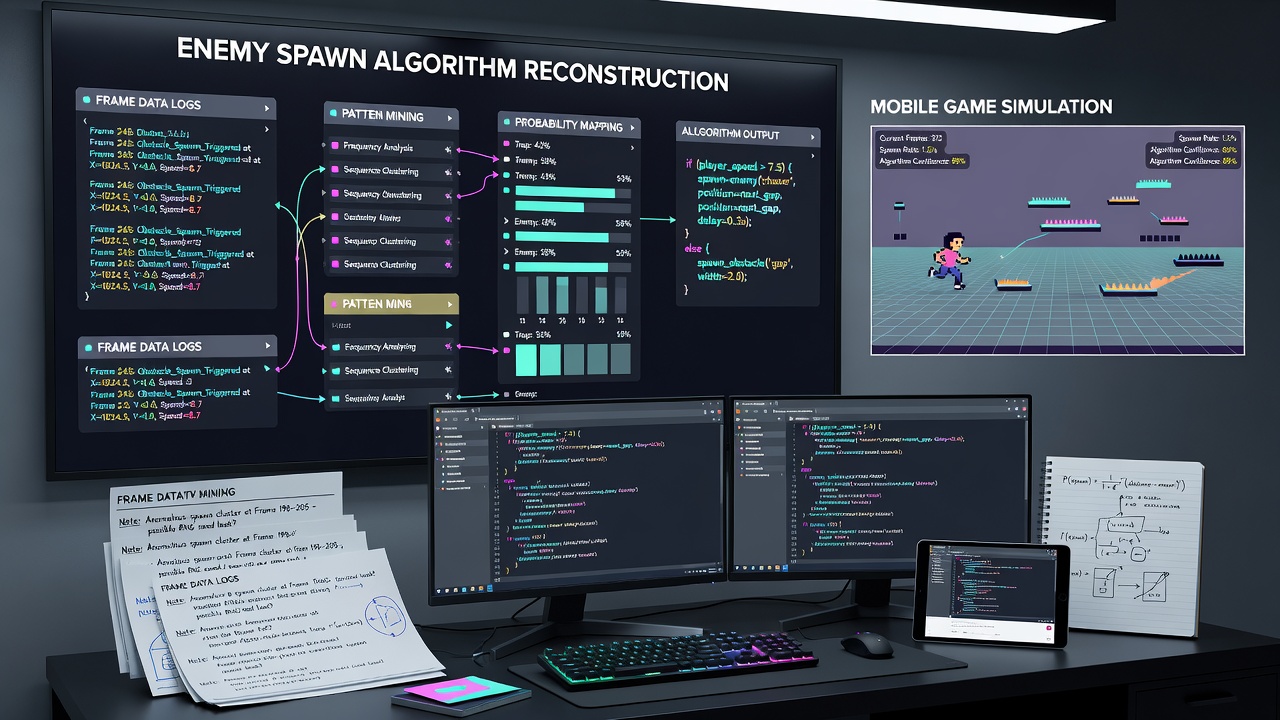
Endless runner mobile titles rely on procedural systems that generate enemy placements in real time, and developers capture these events through frame data logs that record timestamps, positions, velocities, and object identifiers at intervals of 16.67 milliseconds on standard 60 FPS sessions. Researchers extract spawn patterns by parsing these logs into structured datasets where each entry includes frame number, enemy type, spawn coordinates, and trigger conditions tied to player progress metrics such as distance traveled or score thresholds.
Frame Data Collection in Mobile Environments
Mobile platforms log frame data through built-in profiling tools that export CSV or JSON files containing arrays of game state snapshots, and analysts filter these files to isolate spawn events by matching object creation calls with their corresponding frame indices. Data shows that spawn algorithms often use seeded random functions modulated by player speed curves, where acceleration phases trigger denser obstacle clusters while constant velocity segments produce more predictable intervals. Studies from institutions like the University of Waterloo indicate that log granularity improves reconstruction accuracy when recordings include both client-side and server-authoritative timestamps, reducing desync errors common in asynchronous mobile network conditions.
Algorithm Reconstruction Techniques
Analysts apply reverse engineering methods that map observed spawn sequences back to probable procedural rules by clustering similar patterns across multiple play sessions, then fitting mathematical models such as Poisson distributions or Markov chains to the frequency and spacing of enemy appearances. One study revealed that certain titles employ layered probability tables where base spawn rates adjust dynamically according to elapsed playtime and accumulated player actions, while secondary modifiers introduce rare elite variants at fixed distance milestones. Observers note that correlation analysis between frame timestamps and environmental variables like lane availability or power-up states helps isolate conditional branches within the spawn logic.
Tools and Data Processing Pipelines
Specialized scripts written in Python or R process raw frame logs by converting timestamp sequences into time-series graphs that highlight spawn density peaks, and these visualizations allow identification of algorithmic breakpoints where spawn rates shift abruptly. Machine learning classifiers trained on labeled datasets from titles such as Temple Run derivatives can predict next-spawn probabilities with increasing precision as log volume grows, according to figures released by the International Game Developers Association in mid-2025. Processing pipelines often incorporate noise reduction filters to account for dropped frames or variable device performance that might otherwise distort interval measurements.
Reconstruction efforts benefit from cross-referencing multiple log sources collected under controlled conditions, including runs at different device refresh rates and input sampling frequencies. Data from Canadian research groups demonstrates that aligning logs from high-end and budget hardware reveals hardware-specific spawn throttling mechanisms that preserve consistent difficulty curves across varied player devices.
Practical Applications and Case Examples
Game balance teams use reconstructed algorithms to simulate millions of play sessions without running full game builds, identifying potential difficulty spikes before public releases. In July 2026 industry reports highlighted several studios integrating these reconstruction methods into automated testing suites that flag unbalanced spawn sequences within hours rather than days of manual playtesting. External links to academic repositories, such as papers hosted by the ACM Digital Library, provide open datasets from prior mobile title analyses that serve as benchmarks for validating new reconstruction scripts.
Take one research team that parsed logs from a popular endless runner update cycle and discovered that spawn density scaled logarithmically with session length, a pattern confirmed across thousands of recorded runs. Those who've examined similar datasets often discover hidden state machines that switch between aggressive and conservative modes based on recent player survival streaks. Such findings enable precise documentation of how procedural systems maintain engagement without requiring access to proprietary source code.
Challenges in Accurate Reconstruction
Obfuscated logging formats and encrypted data streams present initial barriers, requiring analysts to develop custom parsers that handle variable-length records and checksum validations. Network latency can introduce timestamp offsets that skew interval calculations, yet mitigation strategies such as relative frame delta analysis rather than absolute clock times have proven effective according to reports from the European Games Developer Federation. Variability in random number generator implementations across different mobile operating systems further complicates pattern matching, demanding platform-specific calibration steps before model fitting begins.
Despite these obstacles, iterative refinement of reconstruction models yields progressively reliable approximations of original spawn logic. Researchers continue to publish methodological improvements that address edge cases like rapid direction changes or simultaneous multi-lane spawns, expanding the toolkit available for data-driven game analysis.
Conclusion
Reconstruction of enemy spawn algorithms from frame data logs supplies detailed insight into the procedural foundations of endless runner mobile titles, supporting both academic inquiry and professional development workflows. Continued refinement of analysis techniques, combined with growing availability of public datasets, positions this approach as a standard component in the study of real-time game systems.