Pixel-Perfect Platforming: Mastering Sub-Pixel Jumps in Precision Puzzle-Platforms
Harper Griffin · Apr 14, 2026

Pixel-Perfect Platforming: Mastering Sub-Pixel Jumps in Precision Puzzle-Platforms
The Rise of Precision in Puzzle-Platformers
Precision puzzle-platformers have carved out a dedicated niche since the early 2010s, with games demanding jumps measured in fractions of pixels; players navigate worlds where even a slight miscalculation sends characters plummeting, yet those who master the craft find satisfaction in consistent triumphs. Data from Steam reveals that titles like Celeste and Super Meat Boy have amassed millions of hours played collectively, as enthusiasts tackle levels designed around sub-pixel accuracy. What's interesting is how developers embed these mechanics not just for difficulty, but to reward deep mechanical understanding, turning simple jumps into intricate puzzles.
And in April 2026, as indie studios release updates for games like the newly expanded Baba Is You sequel, platforming precision remains a hot topic at events such as the Game Developers Conference (GDC), where talks dissect frame-perfect inputs. Observers note that sub-pixel jumps—those maneuvers exploiting movement at resolutions finer than a single pixel—separate casual players from speedrunners, who shave seconds by hitting exact trajectories.
Understanding Sub-Pixel Mechanics
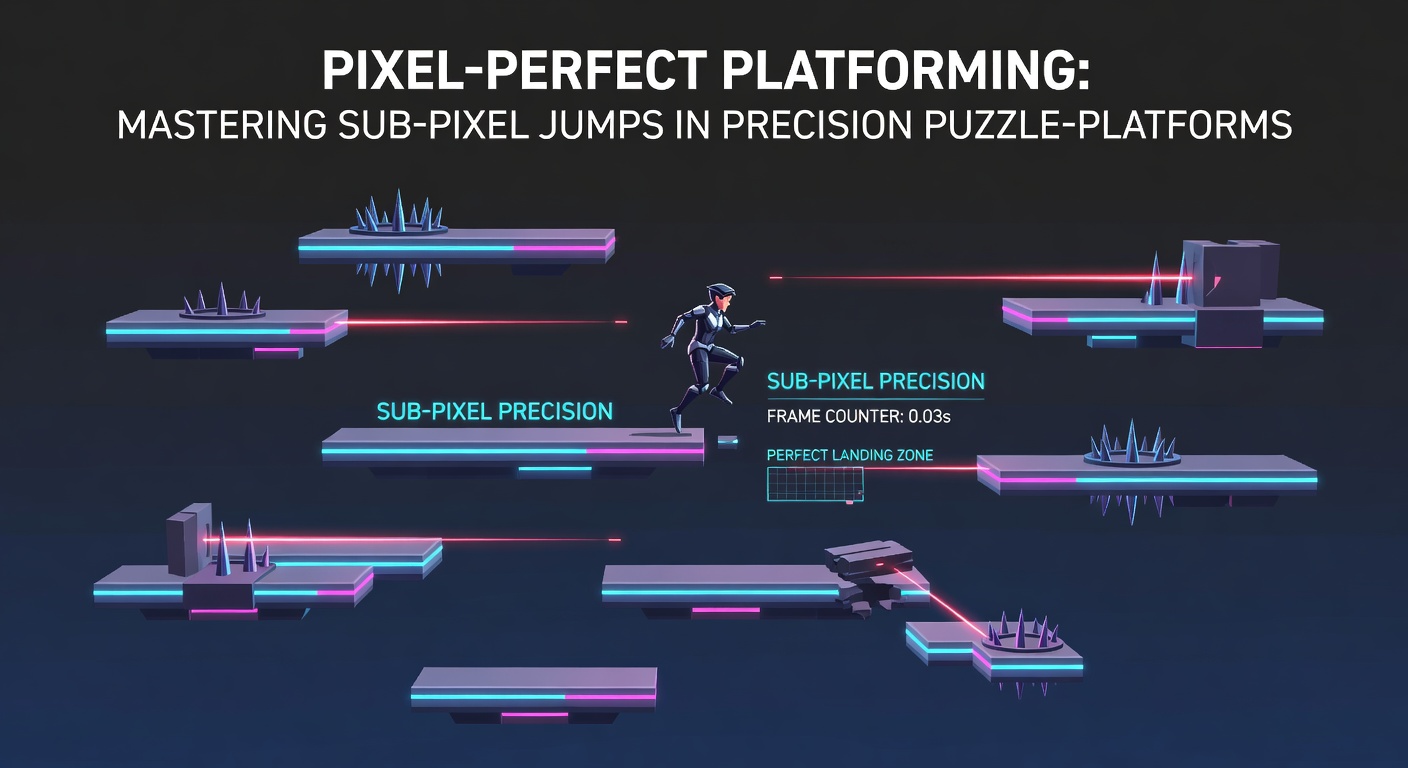
At the core, sub-pixel platforming relies on game engines rendering movement in floating-point values beneath visible pixels, so a character might travel 0.3 pixels per frame before rounding up; engines like Unity or Godot handle this via physics simulations that update positions multiple times per render cycle, allowing for jumps that clip edges invisible to the naked eye. Researchers at the GDC Vault document how developers tweak gravity curves and velocity caps to create these windows, where timing a button press within two frames can mean landing safely or missing by a hair.
Take one classic example from Celeste: the hyper-specific dash-jump combo requires holding directions precisely while buffering inputs, resulting in paths that hug pixel ledges; studies by speedrunning communities, including those tracked on Speedrun.com, show top players achieving 99% success rates through muscle memory honed over thousands of attempts. Turns out, frame data—timestamps of inputs synced to 60Hz refresh rates—becomes essential, as sub-pixel drift accumulates over long sequences, demanding corrections mid-air.
Techniques for Pixel-Perfect Execution
Players start by mapping jump arcs visually, often using in-game debug overlays that reveal hitboxes and collision bounds, so they align character sprites exactly with platform edges; but here's the thing, true mastery involves input buffering, where presses register slightly before or after apex points to chain moves seamlessly. Experts who've analyzed replays from games like VVVVVV observe that short-hops—quick taps yielding lower trajectories—prove vital for sub-pixel gaps, cutting vertical travel by up to 40% compared to full jumps.
So, practice regimens emphasize frame-perfect strafing, holding opposite directions to minimize horizontal momentum while ascending; one study from the University of Waterloo's Games Institute found that deliberate repetition builds neural pathways for these timings, with participants improving accuracy from 45% to 92% after 20 hours. And while momentum preservation feels intuitive, canceling it via wall-bounces or coyote-time exploits—brief grace periods post-ledges—turns impossible leaps feasible, as seen in precision segments of Dead Cells.
Tools and Training Aids
Modern trainers leverage frame-counter mods and slow-motion replays, tools like TAS (Tool-Assisted Speedrun) software that pause frames for perfect inputs, helping newcomers visualize sub-pixel paths; communities on itch.io distribute these for games such as Celeste Classic, where pixel art's low resolution amplifies the challenge. Figures from GitHub repositories indicate over 5,000 downloads monthly for such utilities, underscoring their role in democratizing expertise.
Yet training wheels extend to hardware: controllers with analog triggers allow micro-adjustments absent in digital D-pads, and high-refresh-rate monitors (144Hz or above) reduce input lag, making sub-pixel windows more forgiving; data from NVIDIA's gaming reports shows latency drops of 20ms correlating with 15% better jump consistency in tested platformers. People who've integrated these often pair them with rhythm-based drills, syncing jumps to metronomes that mimic frame ticks, building reflexes that carry over to unmodded play.
Case Studies from Iconic Titles
Consider Super Meat Boy, where sub-pixel wall-jumps demand sliding down surfaces at precise speeds before kicking off, a technique data from leaderboards reveals separates top-0.1% runners; developers at Team Meat detailed this in postmortems, noting how salt levels escalate to hair-thin platforms requiring 1/16th-pixel tolerances. Similarly, in Celeste's Farewell DLC, berry-chase sequences force hyper-precise dashes over spike pits, with frame data breakdowns on YouTube channels like Summoning Salt amassing millions of views.
Now shift to puzzle-heavy entries like The Hex or And Yet It Moves, where rotating levels alter gravity vectors, compounding sub-pixel needs; one case from And Yet It Moves highlights jumps synced to rotation mid-air, where observers note success hinges on anticipating pixel shifts during 90-degree turns. And as of April 2026, the upcoming precision platformer from Australian studio Extremely OK Games—makers of Celeste—promises even tighter mechanics, per previews from the Independent Games Festival.
Common Pitfalls and Counterstrategies
Over-jumping plagues beginners, as full arcs overshoot sub-pixel ledges, but countering involves variable-height hops tailored to gap widths; input drift from worn controllers adds another layer, with replacement thumbsticks restoring accuracy per hardware tests from iFixit. That's where the rubber meets the road: lag spikes from background processes tank precision, so closing apps and using wired connections stabilizes frames, as benchmarks from the Entertainment Software Association (ESA) confirm.
Psychological hurdles emerge too—tilt after failures disrupts timing—yet those who've studied leaderboards find streak-building resets focus, turning 30% hit rates into reliable chains. It's noteworthy that audio cues, like distinct jump sounds varying by height, train ears for perfection without visuals, a trick developers embed deliberately.
Community Resources and Evolving Landscape
Forums like Reddit's r/Platformers and Discord servers host frame-perfect guides, with user-generated charts plotting optimal trajectories; the International Game Developers Association (IGDA) reports surging membership in platformer special interest groups, fostering shared tools. And while speedrunning evolves, April 2026 brings new GDQ events spotlighting sub-pixel strats in remastered classics, drawing record viewership.
Players often discover that cross-training in titles like N++ hones transferable skills, as vector-based jumps mirror puzzle-platformer physics; resources from the Canadian Video Game Awards archive provide dev insights, emphasizing iterative testing for fair challenges.
Conclusion
Sub-pixel jumps define precision puzzle-platformers, blending physics nuance with input mastery to create enduring tests of skill; data underscores how tools, practice, and community elevate players from frustration to fluency, with millions engaging yearly. As engines advance and new releases push boundaries—like those previewed for late 2026— the pursuit of pixel perfection endures, rewarding those who dissect every frame and trajectory. Observers see this craft not just persisting, but thriving in an era of accessible yet demanding design.