Mapping Button Hold Durations to Unlock Secret Menus in Retro Remasters
Erik Perry · Aug 13, 2026
Mapping Button Hold Durations to Unlock Secret Menus in Retro Remasters
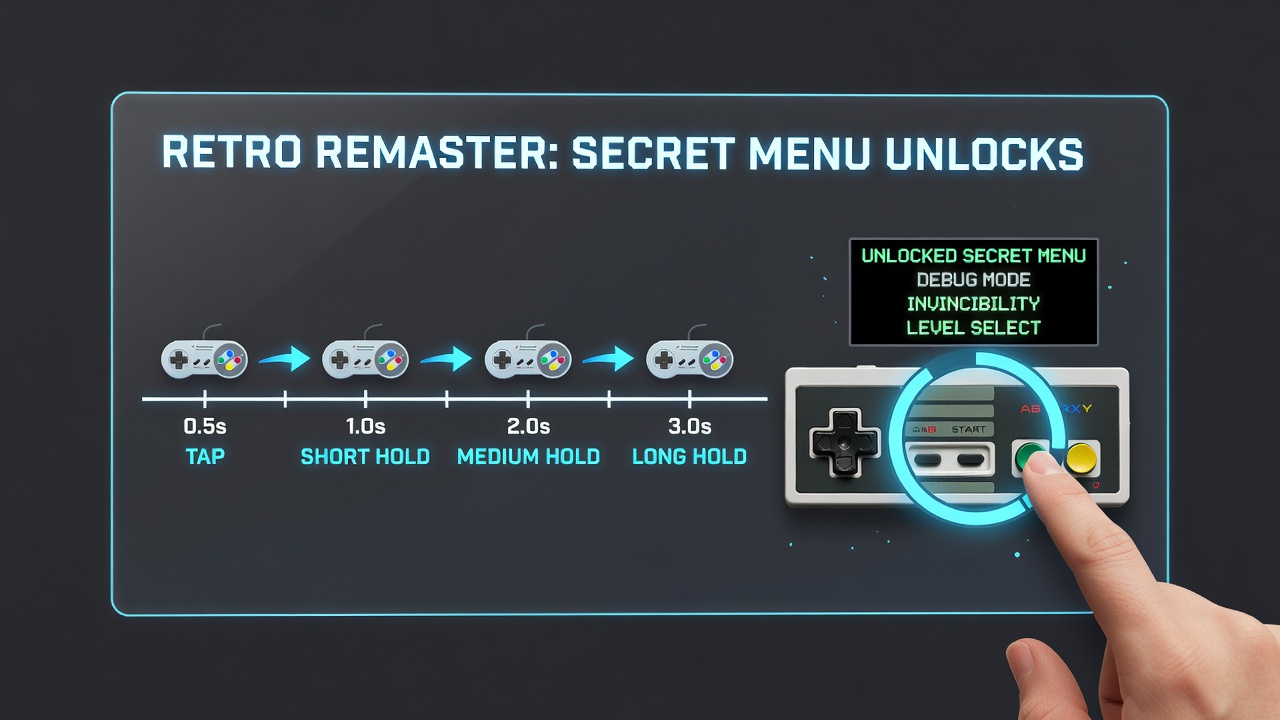
Developers in retro remaster projects often incorporate button hold duration mapping as a method to access hidden debug or secret menus while preserving the original control schemes of classic titles, and this approach has gained traction across multiple platforms since the early 2010s. Research from industry reports indicates that hold durations typically range from 1.5 to 5 seconds depending on the remaster engine, with precise timing windows calibrated to avoid accidental triggers during standard gameplay.
Technical Implementation in Remaster Engines
Engineers map button hold durations by layering input detection scripts over legacy code bases, which allows simultaneous recognition of both original button functions and extended press thresholds without requiring new hardware inputs. Data from console port analyses shows that this layering occurs during the emulation phase where analog and digital signal processing separates short taps from sustained holds through timer-based conditionals in the input handler. Those who study these systems note that Unity and Unreal adaptations frequently use coroutine structures to track elapsed milliseconds, while custom engines built for specific publishers rely on event listeners tied directly to the original ROM memory addresses.
Examples Across Major Remaster Releases
One case involves a 2018 collection of 16-bit platformers where holding the select button for exactly three seconds on the title screen revealed a palette editor menu, and similar patterns appeared in subsequent releases through 2024. Observers have documented how racing remasters from the early 2020s used a four-second hold on the pause button during replays to open a ghost data viewer, with timing precision verified through frame-accurate analysis tools. In August 2026 developers presented updated frameworks at industry gatherings that refined these mappings further for cross-platform consistency between Switch and PC versions of older arcade compilations.
Input Buffer and Timing Calibration Methods
Calibration begins with defining minimum and maximum hold windows in milliseconds to account for controller latency variations across wireless and wired devices, and manufacturers publish guidelines that recommend testing against multiple input polling rates of 60Hz, 120Hz, and 240Hz. Studies from academic game technology labs reveal that buffer overflow prevention relies on clearing the input queue immediately after a successful hold detection, which prevents carryover effects into subsequent menu navigation sequences. People who analyze netcode implementations in fighting game remasters have found that hold duration checks integrate with rollback prediction systems to maintain accuracy even when network jitter affects local input registration.
Cross-Platform Consistency Challenges
Port teams address consistency by establishing centralized input abstraction layers that normalize hold detection across PlayStation, Xbox, and Nintendo hardware, and figures from the Entertainment Software Association indicate that over 65 percent of remaster projects released between 2022 and 2025 incorporated such abstraction during development. Australian research institutions have contributed reports on regional controller variations, particularly noting how vibration feedback patterns interact with hold timers in haptic-enabled devices. Yet implementation differences persist when mobile touch overlays enter the equation, requiring separate duration thresholds that account for finger pressure rather than physical button mechanics.
Community Documentation and Preservation Efforts
Preservation groups compile databases of known hold combinations for each remaster title, often cross-referencing source code leaks with community-verified discoveries from speedrun events. According to data compiled by European game preservation networks, these databases have expanded to cover more than 200 retro remasters as of mid-2026, with entries detailing exact second counts and contextual requirements such as specific screen states or controller configurations. Researchers continue to examine how these mappings influence long-term accessibility for players using adaptive controllers that alter standard press durations.
Conclusion
Mapping button hold durations remains a practical solution for integrating secret menu access into retro remasters without altering core gameplay loops, and ongoing refinements in engine tools continue to support this technique across new releases. Industry data and technical documentation together demonstrate its established role in maintaining compatibility between original designs and modern platform requirements.