Interpreting Quest Log Metadata for Reconstructing Optimal Completion Orders in Branching Narrative Experiences
Ines Wolf · Jun 11, 2026

Interpreting Quest Log Metadata for Reconstructing Optimal Completion Orders in Branching Narrative Experiences
Quest logs in branching narrative games store structured metadata that tracks player progress through interconnected storylines, and developers along with analysts examine these records to map out efficient completion sequences. Each entry typically contains timestamps for quest acceptance and resolution, boolean flags indicating availability or completion, and variable states that reflect choices made earlier in the experience. Researchers parse these elements to identify prerequisite chains, because certain quests unlock only after specific conditions resolve while others branch based on prior decisions.
Data structures often include arrays of completed objectives alongside conditional triggers, so reconstruction begins with sorting entries chronologically and cross-referencing flags against narrative dependency graphs. Observers note that this approach reveals hidden ordering constraints that players encounter when multiple paths diverge yet converge later in the story. In June 2026 industry presentations highlighted updated parsing libraries that handle complex variable interactions across large quest sets, allowing faster extraction of optimal routes from existing save data.
Metadata Components and Their Analytical Value
Timestamps provide the backbone for sequencing analysis because they establish the real order in which events occurred during play sessions, whereas state flags mark whether a quest remains active, failed, or succeeded under particular conditions. Variable fields capture numeric or enumerated outcomes from player choices, and these values frequently determine which subsequent quests appear in the log. Analysts combine these fields into dependency matrices that show which quests must precede others to avoid dead ends or missed content branches.
Studies from the University of Alberta's game research group have examined how such matrices scale when narrative trees exceed several hundred quests, and the resulting diagrams help identify choke points where multiple branches compete for limited player time. Those who've processed large datasets find that missing metadata entries often indicate optional content skipped entirely, which in turn affects calculations for total completion efficiency.
Reconstruction Techniques for Branching Structures
Graph-based algorithms treat each quest as a node and draw directed edges from prerequisites to dependent tasks, after which topological sorting produces candidate orderings that respect all recorded constraints. When branches introduce mutually exclusive paths, the metadata reveals divergence points through conflicting flag states, and analysts then evaluate reward density or resource costs along each fork to rank sequences. External tools import log files directly from common game engines, converting raw entries into standardized formats that support automated comparison across multiple playthroughs.
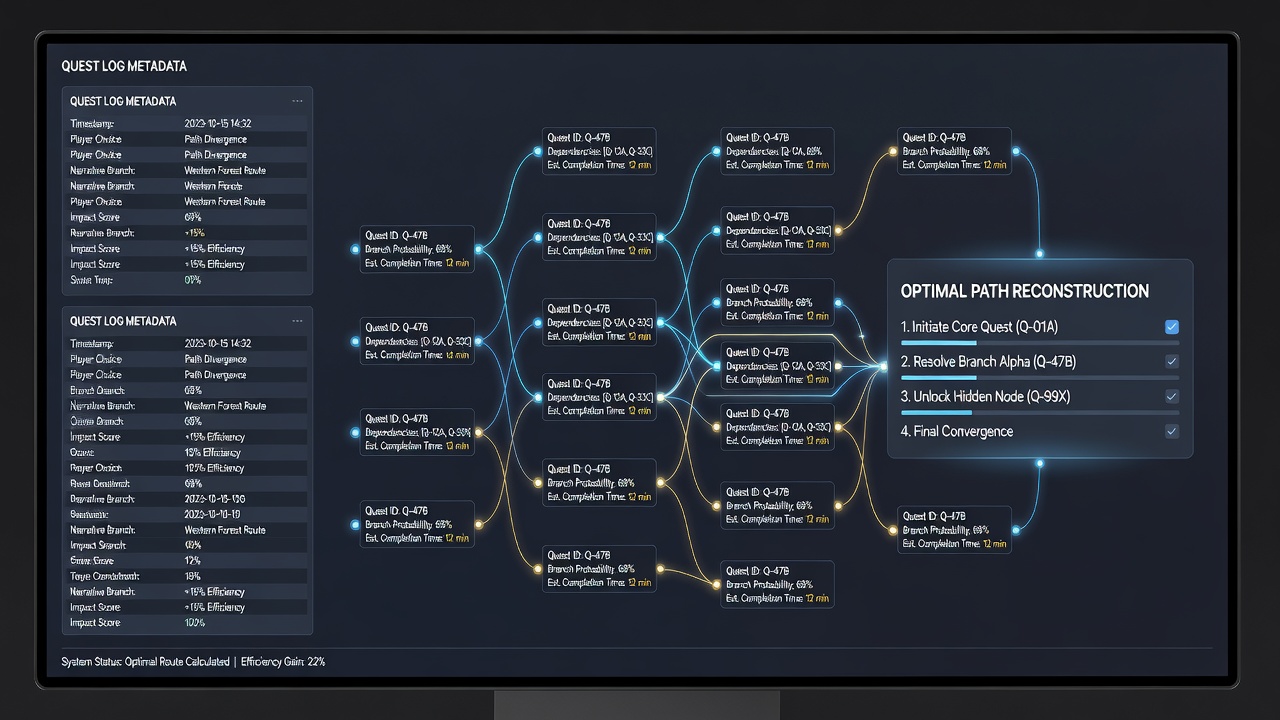
One case involved a title with over forty interconnected side stories where metadata showed that completing a particular hub quest early unlocked parallel branches that shared resources, reducing total travel time across regions. Pattern recognition across thousands of exported logs has allowed researchers to cluster similar player behaviors and extract representative sequences that minimize backtracking without sacrificing story coverage.
Applications in Design and Player Analytics
Game studios apply these reconstruction methods during post-release updates to adjust quest availability windows based on observed completion rates, and the same techniques support difficulty balancing when certain orders prove consistently more challenging than others. Academic work published through the Digital Games Research Association has documented how metadata analysis informs procedural narrative generators that adapt branch density according to historical player data from similar titles.
Figures from the Entertainment Software Association of Canada indicate steady growth in titles featuring extensive branching systems, which increases demand for reliable log interpretation frameworks. Integration with live telemetry pipelines now lets teams monitor how real-time metadata evolves during early access periods, providing immediate feedback on whether intended optimal orders match actual player behavior.
Challenges and Current Tooling Developments
Encrypted or obfuscated log formats present initial barriers because they require reverse-engineering steps before metadata becomes readable, while dynamic quest systems that generate new entries at runtime complicate static graph construction. Recent open-source projects address these issues through modular parsers that support multiple engine formats and output visualization layers for quick validation of reconstructed sequences. Cross-platform compatibility remains an ongoing focus as mobile and console versions sometimes store metadata differently despite sharing core narrative assets.
Conclusion
Interpreting quest log metadata supplies concrete methods for mapping efficient traversal through branching narratives, and continued refinement of parsing tools supports both development pipelines and academic inquiry into interactive storytelling structures. As datasets grow larger and more diverse, the precision of reconstructed completion orders improves accordingly, offering clearer pictures of how players navigate complex choice networks across contemporary releases.