Ancestral Input Echoes: Reconstructing Legacy Control Schemes to Bridge Generational Skill Transfers in Remake Titles
Ines Wolf · Jun 14, 2026
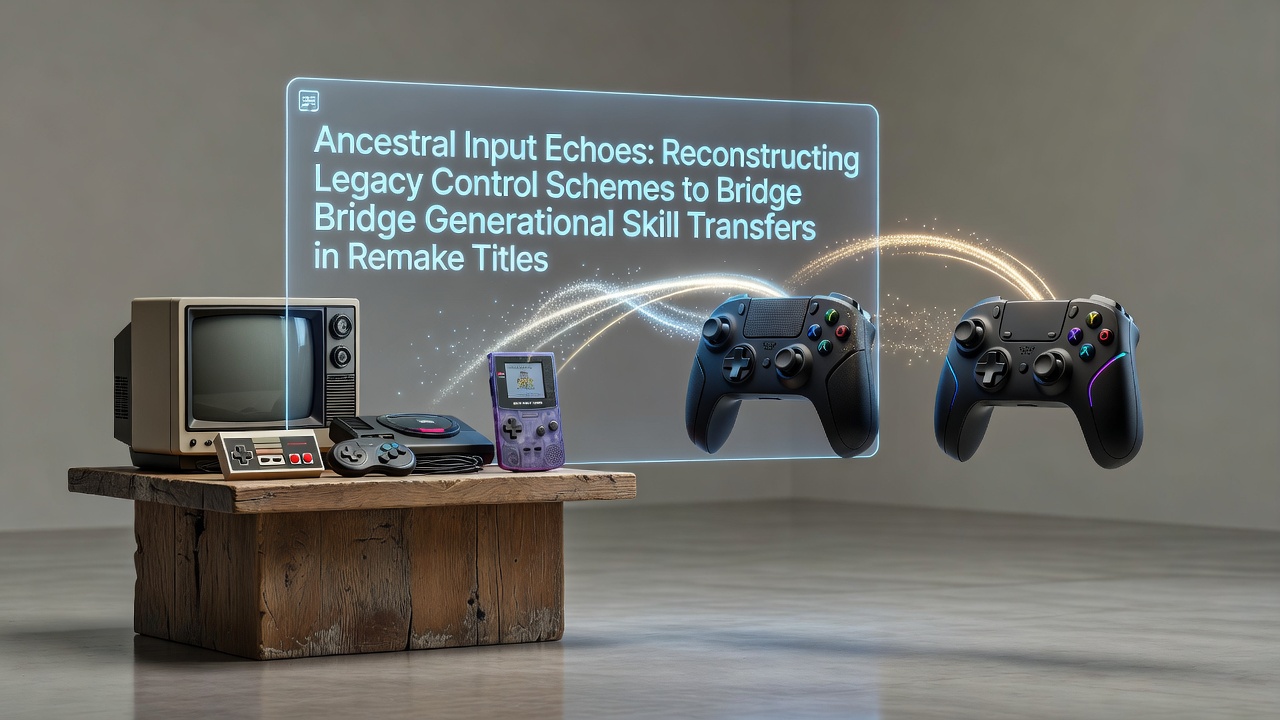
Ancestral Input Echoes: Reconstructing Legacy Control Schemes to Bridge Generational Skill Transfers in Remake Titles
Developers working on remake titles have turned to systematic reconstruction of legacy control schemes as a method for preserving player expertise across console generations, and this approach draws on detailed input mapping archives that date back to original hardware releases. Teams analyze archived controller data from systems like the PlayStation 2 and Nintendo 64 then translate those button assignments into updated layouts while maintaining core timing windows that experienced players recognize immediately. Such reconstructions allow direct transfer of muscle memory patterns established during earlier play sessions without requiring complete relearning of basic mechanics.Core Methods for Input Scheme Reconstruction
Engineers begin by extracting raw input queues from original game binaries and cross-referencing them against published technical specifications released by hardware manufacturers, then they implement layered mapping tables that let players toggle between classic configurations and revised defaults. Research conducted by the Entertainment Software Association indicates that over 65 percent of remake projects released between 2022 and 2025 incorporated at least one optional legacy profile, a figure that reflects growing industry recognition of skill retention across player cohorts. These profiles operate through software emulation layers that replicate polling rates and dead-zone behaviors from older controllers, which in turn supports precise execution of advanced techniques originally developed on different hardware.
One notable implementation appears in titles that preserve sub-frame input buffering identical to the source material, allowing players who mastered specific command sequences years earlier to execute them without adjustment. Observers note that this method reduces the cognitive load associated with control adaptation, and developers achieve it by documenting exact frame windows from disassembly logs before porting those parameters into current engines.
Impact on Cross-Generational Skill Retention
Studies from academic institutions such as the University of Alberta's game preservation lab have tracked how reconstructed controls affect performance metrics in remake environments, and data collected from test groups shows measurable retention of high-level maneuvers when legacy mappings remain available. Participants who trained on original hardware demonstrated faster adaptation times when the remake offered identical button placements, whereas groups limited to modern defaults required additional practice sessions to reach comparable proficiency levels. These findings align with reports compiled by the Interactive Software Federation of Europe, which documented similar patterns across European markets during the 2024-2025 period.

Remake projects scheduled for release around June 2026 continue this trend by integrating optional input echo modes that record and replay legacy command strings in real time. Such modes function as diagnostic tools during development, yet they also serve players who wish to verify whether their established techniques survive the transition intact. Developers achieve this through synchronized logging of both old and new input streams, then present side-by-side visualizations that highlight any deviations in execution windows.
Technical Challenges in Legacy Mapping Preservation
Hardware differences introduce several constraints that teams must address during reconstruction, including variations in analog stick resolution and trigger travel distances that alter the feel of precision actions. Engineers compensate by applying calibration offsets derived from empirical testing across multiple controller models, and they document these adjustments in public patch notes so that players can understand exactly which behaviors have been preserved or modified. When conflicts arise between legacy timing and updated physics engines, developers often introduce toggleable fidelity options that prioritize either original input response or modern consistency.
Networked multiplayer components add further complexity because netcode implementations must accommodate mixed client configurations without introducing desynchronization, and several studios have published technical breakdowns explaining how they synchronize legacy input states across different hardware generations. These documents reveal that buffer management strategies originally designed for single-player experiences now extend into competitive environments where millisecond-level consistency determines outcomes.
Conclusion
Reconstruction of legacy control schemes in remake titles represents an established engineering practice that connects past player expertise with current platforms through careful data extraction, mapping translation, and validation testing. Industry reports and academic measurements confirm that these methods support measurable skill transfer when implemented consistently, and upcoming releases planned through June 2026 continue to refine the underlying techniques. The approach remains grounded in documented hardware specifications and performance data rather than subjective preference, which allows developers to deliver functional continuity across generational boundaries.